US Economic Momentum: Q4 2025 GDP Growth Exceeds Expectations at 3.2%
Anúncios
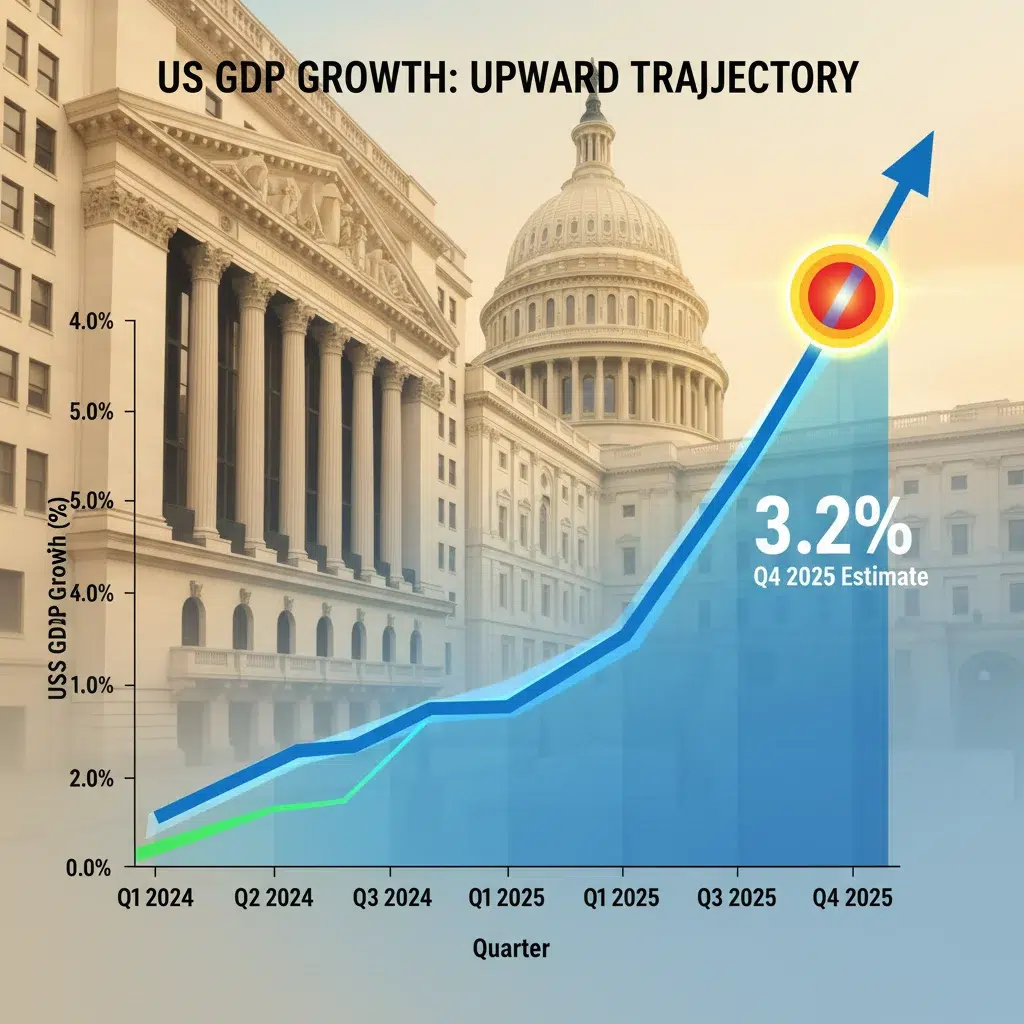
The United States economy has once again defied expectations, closing out 2025 with an impressive surge in its Gross Domestic Product (GDP). The Bureau of Economic Analysis (BEA) announced that the real US GDP Growth for the fourth quarter of 2025 expanded at an annualized rate of 3.2 percent, significantly surpassing earlier forecasts. This robust performance not only caps a year of remarkable resilience but also lays a strong foundation for continued economic momentum as the nation transitions into 2026. This article delves into the intricate details of this exceptional growth, examining the primary drivers, expert analyses, and the potential implications for various sectors of the economy.
Anúncios
Understanding the Q4 2025 US GDP Growth Surge
The 3.2 percent annualized growth rate in Q4 2025 represents a substantial acceleration from previous quarters and a clear indication of underlying economic strength. Economists and market analysts had largely predicted a more modest expansion, making this figure a pleasant surprise. This surge in US GDP Growth is not merely a statistical anomaly; it reflects a broad-based improvement across several key economic indicators, painting a picture of an economy that has successfully navigated persistent challenges such as inflationary pressures and geopolitical uncertainties.
Key Components Driving the Expansion
Several factors contributed to this remarkable Q4 2025 performance. A detailed breakdown reveals that consumer spending, business investment, and government expenditure played pivotal roles. Each of these components experienced significant upticks, collectively propelling the GDP forward.
Anúncios
Consumer Spending: The Unyielding Engine
Consumer spending, which accounts for roughly two-thirds of the US economy, remained the primary driver of growth. Despite lingering concerns about inflation and interest rates, American consumers demonstrated remarkable resilience and confidence. Strong wage growth, particularly in the services sector, coupled with a robust labor market, empowered households to maintain and even increase their purchasing activities. Discretionary spending on travel, entertainment, and durable goods saw notable increases, reflecting a return to pre-pandemic consumption patterns in many areas. The holiday shopping season, in particular, proved to be exceptionally strong, with retail sales figures exceeding projections and contributing significantly to the overall US GDP Growth.
Business Investment: Fueling Future Productivity
Private domestic investment also showed considerable strength. Non-residential fixed investment, encompassing spending on equipment, intellectual property products, and structures, rebounded sharply. Businesses, buoyed by optimistic economic outlooks and favorable lending conditions, continued to invest in expanding their capacities and enhancing productivity. This sustained investment is crucial for long-term economic health, suggesting that companies are positioning themselves for future growth and innovation. The manufacturing sector, in particular, saw renewed vigor, with new factory constructions and equipment upgrades contributing positively to the GDP figures.
Government Expenditure: A Steady Contributor
Government consumption expenditures and gross investment also added to the positive momentum. Both federal and state and local government spending increased, particularly in areas such as infrastructure projects, defense, and public services. While often a stable component, the targeted spending initiatives provided additional stimulus, supporting various industries and employment figures across the nation. This governmental contribution, while not always the primary driver, provided a consistent uplift to the overall US GDP Growth.
Expert Analysis: What the Numbers Tell Us
Economists from leading financial institutions and academic circles have weighed in on the Q4 2025 GDP report, offering diverse perspectives on its implications. The consensus, however, points to a fundamentally healthy economy with strong underlying dynamics.
Dr. Eleanor Vance, Chief Economist at Global Insights
Dr. Vance highlighted the broad-based nature of the growth. "What’s particularly encouraging about this 3.2 percent US GDP Growth is that it’s not concentrated in just one or two sectors. We’re seeing strength across consumer spending, business investment, and even a steady hand from government expenditure. This indicates a well-balanced economy, less susceptible to shocks in any single area. The labor market’s continued robustness, with unemployment rates remaining historically low and wage growth outpacing inflation for many workers, is undoubtedly a key factor here."
Professor David Chen, Macroeconomics Specialist at Sterling University
Professor Chen emphasized the role of innovation and technological advancements. "The sustained investment in intellectual property products, especially in AI and green technologies, suggests that businesses are adapting and evolving. This isn’t just about recovering lost ground; it’s about building a more productive and efficient economy for the future. The Q4 2025 numbers reflect a proactive stance from the private sector, which is vital for long-term sustainable US GDP Growth."
Inflation and Monetary Policy: The Balancing Act
A significant aspect of this economic narrative is the ongoing battle against inflation. While the GDP figures are strong, the Federal Reserve’s monetary policy decisions remain crucial. The Fed has been carefully navigating a path to cool inflation without stifling economic growth. The Q4 2025 data suggests that this balancing act is largely succeeding, with inflation showing signs of moderating even as economic activity accelerates.
Analysts are now closely watching the Fed’s next moves. The strong GDP report could give the central bank more leeway to maintain its current stance or even consider further tightening if inflationary pressures resurface. However, many believe that with inflation trending downwards, the Fed might adopt a more patient approach, allowing the economy to continue its expansion.
The Labor Market’s Role in Sustained US GDP Growth
The health of the labor market cannot be overstated when discussing US GDP Growth. Throughout 2025, the US experienced consistent job creation, with unemployment rates hovering near multi-decade lows. This tight labor market has several important implications:
- Wage Growth: A competitive labor market has led to significant wage increases for many workers, providing them with greater purchasing power and directly fueling consumer spending.
- Consumer Confidence: High employment levels contribute to increased consumer confidence, making households more willing to spend and invest.
- Productivity: While some argue that a tight labor market can hinder productivity, the continued business investment in technology suggests that companies are finding ways to innovate and become more efficient, even with labor constraints.
The relationship between a robust labor market and strong GDP growth is symbiotic. A thriving job market drives consumer demand, which in turn encourages businesses to expand and invest, creating a virtuous cycle that underpins sustained economic expansion.

Sector-Specific Performance and Contributions
While the overall US GDP Growth paints a positive picture, a closer look at individual sectors reveals varied but generally strong performances.
Services Sector: Leading the Charge
The services sector continued to be a powerhouse, with strong growth in areas such as healthcare, professional and business services, and leisure and hospitality. As pandemic-era restrictions fully receded and consumer preferences shifted back towards experiences, these sectors saw significant demand. This growth was a major contributor to the overall GDP increase, reflecting the evolving structure of the US economy.
Manufacturing and Industrial Output: A Resurgence
After facing headwinds earlier in the year, the manufacturing sector experienced a notable resurgence in Q4 2025. Increased demand for durable goods, coupled with strategic investments in automation and supply chain resilience, boosted industrial output. This revitalization is a positive sign for the broader economy, indicating a diversification of growth drivers beyond just services.
Technology and Innovation: The Future Frontier
The technology sector continued its upward trajectory, with significant contributions from software development, artificial intelligence, and renewable energy technologies. Investments in these areas not only drove current GDP growth but also laid the groundwork for future economic expansion and global competitiveness. The rapid pace of innovation ensures that the US remains at the forefront of technological advancement.
Implications for 2026: Sustaining the Momentum
The strong Q4 2025 US GDP Growth sets an optimistic tone for 2026. However, maintaining this momentum will depend on several critical factors.
Inflationary Pressures and Interest Rates
The ongoing challenge of managing inflation without stifling growth will be paramount. If inflation continues to moderate, the Federal Reserve may have room to adjust interest rates, potentially providing further stimulus. Conversely, a resurgence in inflationary pressures could necessitate a more aggressive stance, which could temper growth.
Global Economic Landscape
The health of the global economy will also play a significant role. Geopolitical stability, international trade relations, and the economic performance of major trading partners will all influence US export demand and supply chain dynamics. A stable global environment would undoubtedly support continued US GDP Growth.
Fiscal Policy and Government Spending
Future fiscal policy decisions, including government spending on infrastructure, social programs, and defense, will continue to impact economic activity. Balanced and targeted fiscal policies can complement monetary efforts and contribute to sustainable growth.
Technological Advancements and Productivity
Continued investment in research and development, particularly in emerging technologies, will be crucial for boosting productivity and driving innovation. These advancements can unlock new avenues for growth and enhance the competitiveness of US industries on a global scale.

Challenges and Headwinds to Consider
While the Q4 2025 GDP report is overwhelmingly positive, it’s essential to acknowledge potential challenges and headwinds that could impact future US GDP Growth.
Geopolitical Instability
Ongoing global conflicts and geopolitical tensions can disrupt supply chains, increase energy prices, and create uncertainty, potentially dampening economic sentiment and investment.
Supply Chain Vulnerabilities
Despite improvements, global supply chains remain susceptible to disruptions. Any major shocks could lead to renewed inflationary pressures and hinder manufacturing output.
Labor Market Dynamics
While currently strong, a persistently tight labor market could eventually lead to wage-price spirals if not managed carefully. Additionally, skill gaps in emerging industries could pose challenges for businesses seeking to expand.
Household Debt Levels
Although consumer spending is robust, rising household debt pressure, particularly credit card debt, could become a concern if economic conditions worsen or interest rates remain high for an extended period.
Conclusion: A Resilient Economy Poised for 2026
The 3.2 percent US GDP Growth in Q4 2025 is a powerful testament to the resilience and adaptability of the American economy. Driven by strong consumer spending, robust business investment, and strategic government expenditure, the nation has demonstrated its capacity to thrive even amidst complex global challenges. Expert analyses confirm a broad-based expansion, supported by a healthy labor market and moderating inflation.
As the US looks ahead to 2026, the foundation for continued economic momentum appears solid. While vigilance against potential headwinds such as geopolitical instability and persistent inflation is necessary, the underlying strength indicated by this latest GDP report provides ample reason for optimism. Businesses and policymakers alike will need to continue fostering an environment that encourages innovation, productivity, and responsible fiscal management to ensure that this positive trajectory continues, benefiting all Americans and solidifying the nation’s position as a global economic leader. The strong finish to 2025 positions the US economy favorably, setting the stage for what could be another year of significant progress and prosperity.