Micro-credentials: Accelerate Your Career 30% Faster by 2026

Anúncios
In an era defined by rapid technological advancements and evolving economic landscapes, the traditional pathways to career success are being redefined. The conventional four-year degree, while still valuable, is increasingly being complemented, and in some cases, challenged, by more agile and targeted forms of education. Enter the world of micro-credentials – a transformative force poised to accelerate career advancement by an astounding 30% faster by 2026. This isn’t just a prediction; it’s a reflection of the growing demand for specialized, job-ready skills that traditional education systems often struggle to deliver at the pace required by industry.
” + “
Anúncios
The concept of micro-credentials career acceleration is fundamentally changing how individuals acquire and demonstrate competence. These short-term, focused learning programs offer verifiable certifications in specific skills or competencies, making them incredibly attractive to both employees seeking to upskill or reskill, and employers in desperate need of a skilled workforce. This article delves deep into the phenomenon of micro-credentials, exploring their rise, their impact on the job market, and how you can leverage them to supercharge your professional journey.
” + “” + “
Anúncios
What Exactly Are Micro-credentials?
” + “
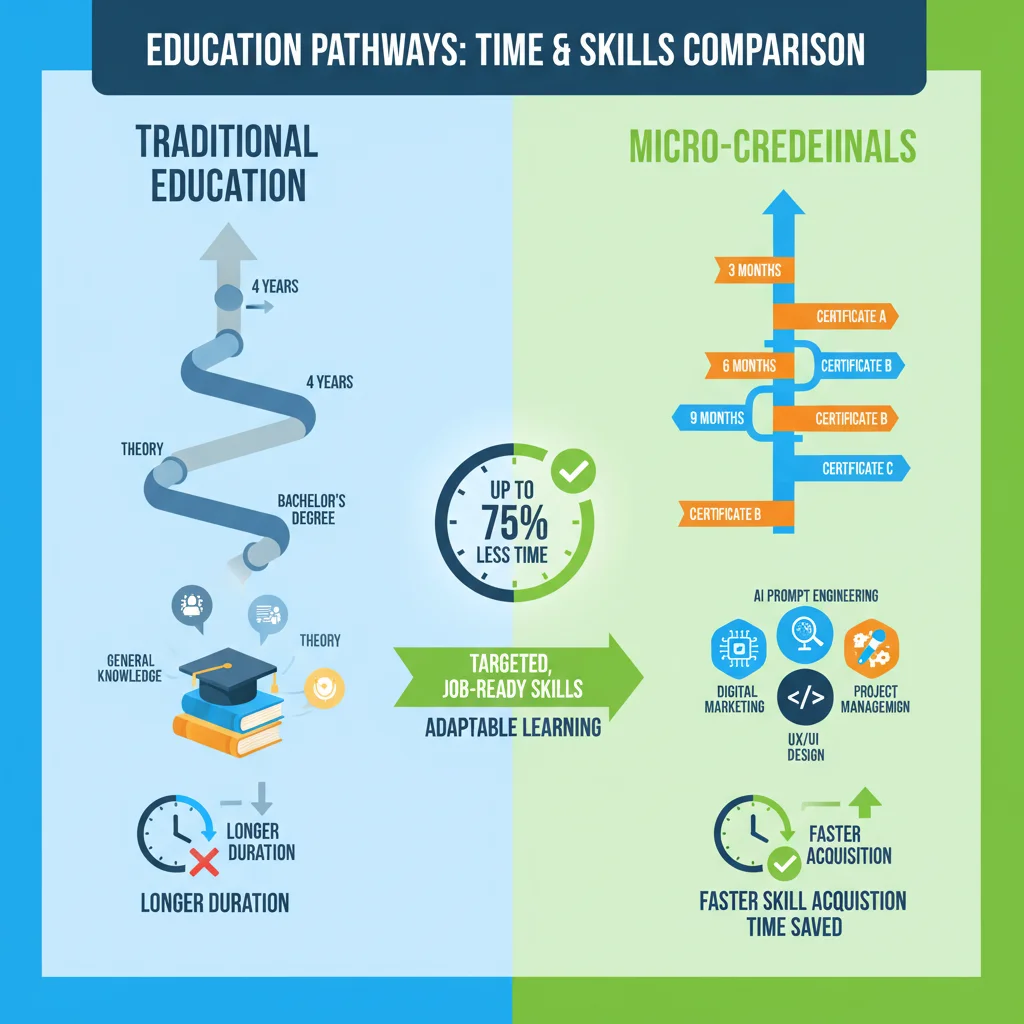
At its core, a micro-credential is a certification that validates a specific set of skills, knowledge, or competencies acquired through a short, focused learning experience. Unlike traditional degrees that cover a broad curriculum over several years, micro-credentials are designed to be highly specific and typically can be completed in weeks or months. They can take various forms, including:
” + “
- ” + “
- Digital Badges: Visual representations of achievements, often shareable online.
- Certificates: Formal recognition of completing a course or program, often issued by universities, colleges, or industry bodies.
- Nanodegrees: Shorter, project-based programs typically offered by online learning platforms.
- Professional Certifications: Industry-recognized credentials for specific tools, software, or methodologies.
” + “
” + “
” + “
” + “
” + “
The key differentiator is their granularity and immediate applicability. They are designed to fill specific skill gaps identified by industries, making their holders instantly more valuable in the job market. This direct link to employability is a primary driver behind the micro-credentials career acceleration trend.
” + “
The Driving Forces Behind the Micro-credential Revolution
” + “
Several macroeconomic and technological shifts are fueling the surge in popularity of micro-credentials:
” + “
1. The Pace of Technological Change
” + “
Industries are evolving at an unprecedented rate. New technologies like AI, blockchain, and advanced analytics emerge constantly, rendering existing skill sets obsolete faster than ever before. Traditional degree programs often struggle to adapt their curricula quickly enough to keep pace. Micro-credentials, with their modular and flexible nature, can be developed and updated rapidly to address these emerging skill demands.
” + “
2. The Skills Gap Crisis
” + “
Many employers report a significant skills gap, struggling to find candidates with the specific competencies needed for modern roles. Micro-credentials provide a targeted solution, allowing individuals to acquire precisely the skills employers are looking for, thereby closing this gap more efficiently.
” + “
3. The Need for Lifelong Learning
” + “
The idea of a single degree sufficing for an entire career is largely outdated. Professionals now understand the necessity of continuous learning and upskilling to remain relevant and competitive. Micro-credentials facilitate this lifelong learning journey by offering digestible, achievable learning objectives.
” + “
4. Accessibility and Affordability
” + “
Compared to traditional degrees, micro-credentials are often significantly more affordable and accessible. They can be pursued online, part-time, and without the stringent entry requirements of a full degree program, opening doors for a wider demographic to invest in their professional development.
” + “
5. Employer Recognition and Value
” + “
Increasingly, employers are recognizing the value of micro-credentials. They signal a candidate’s proactive approach to learning, their ability to acquire new skills efficiently, and their direct relevance to specific job functions. This recognition is a critical factor in their ability to drive micro-credentials career acceleration.
” + “
How Micro-credentials Accelerate Career Advancement by 30% Faster
” + “
The claim of 30% faster career advancement isn’t arbitrary; it stems from several key mechanisms through which micro-credentials impact professional trajectories:
” + “
1. Targeted Skill Acquisition
” + “
Instead of spending years on a broad curriculum, micro-credentials allow individuals to focus intensely on acquiring specific, in-demand skills. This immediate relevance translates directly into enhanced job performance and quicker eligibility for promotions or new roles. For example, a data analyst who completes a micro-credential in advanced Python for data science immediately becomes more valuable than one who only has a general statistics degree.
” + “
2. Enhanced Employability and Competitiveness
” + “
In a competitive job market, candidates with verifiable, specialized skills stand out. Micro-credentials act as powerful signals to recruiters and hiring managers, demonstrating not just theoretical knowledge but practical competence. This can lead to faster job placement, better starting salaries, and quicker progression within an organization.
” + “
3. Bridging Skill Gaps for Promotions
” + “
Often, professionals hit a ceiling in their current roles because they lack a few specific skills required for the next level. Micro-credentials offer a precise way to bridge these gaps without committing to another multi-year degree. This targeted upskilling directly contributes to micro-credentials career acceleration within existing companies.
” + “
4. Facilitating Career Transitions
” + “
For individuals looking to switch careers, micro-credentials provide a low-risk, high-reward pathway. They allow for rapid reskilling in new domains, demonstrating commitment and foundational competence in a new field without the time and financial burden of a second degree. A marketing professional wanting to move into UX design can take a micro-credential in UX principles, gaining essential skills and a portfolio piece much faster than pursuing a full design degree.
” + “
5. Increased Confidence and Adaptability
” + “
Successfully completing micro-credentials builds confidence and fosters a mindset of continuous learning. This adaptability is highly valued by employers and prepares individuals to navigate future changes in the job market, making them more resilient and promotable.
” + “ ” + “
” + “
Real-World Impact and Case Studies
” + “
The impact of micro-credentials is not just theoretical; it’s evident in various sectors:
” + “
- ” + “
- Tech Industry: Companies like Google, IBM, and Microsoft offer their own micro-credentials (e.g., Google IT Support Professional Certificate, IBM AI Engineering Professional Certificate). These are widely recognized and often lead directly to employment opportunities within these companies or their partners.
- Healthcare: Specialized certifications in areas like telehealth, medical coding, or specific medical device operation allow healthcare professionals to expand their roles and take on new responsibilities more quickly.
- Education: Educators are using micro-credentials to specialize in areas like online pedagogy, educational technology, or special education, enhancing their teaching capabilities and career prospects.
- Manufacturing: With the rise of Industry 4.0, micro-credentials in robotics, automation, and data analytics are crucial for reskilling the workforce and maintaining competitiveness.
” + “
” + “
” + “
” + “
” + “
” + “
These examples underscore how micro-credentials career acceleration is not a niche phenomenon but a widespread trend influencing diverse professional fields.
” + “
The Ecosystem of Micro-credentials: Providers and Platforms
” + “
The landscape of micro-credential providers is diverse and expanding rapidly:
” + “
- ” + “
- Online Learning Platforms: Coursera, edX, Udacity, and LinkedIn Learning are major players, partnering with universities and corporations to offer a vast array of specialized programs.
- Universities and Colleges: Many higher education institutions are now offering micro-credentials, often stacking them towards larger degree programs, providing flexible pathways for learners.
- Industry Associations and Professional Bodies: Organizations like CompTIA, PMI (Project Management Institute), and HubSpot offer certifications that are highly valued within their respective industries.
- Corporate Training Programs: Large corporations develop internal micro-credential programs to train and upskill their own employees, ensuring their workforce remains cutting-edge.
” + “
” + “
” + “
” + “
” + “
The proliferation of these providers means that individuals have more choices than ever to find programs that align with their career goals and learning styles, further fueling the micro-credentials career acceleration.
” + “
Navigating the Micro-credential Landscape: Choosing the Right Path
” + “
With so many options available, choosing the right micro-credential can be daunting. Here are key considerations:
” + “
1. Identify Your Career Goals
” + “
What specific skills do you need to acquire to achieve your next career milestone? Research job descriptions for your desired role and identify common skill requirements. This targeted approach is crucial for effective micro-credentials career acceleration.
” + “
2. Research Industry Demand
” + “
Look at labor market data, industry reports, and job trends to understand which skills are most in demand and likely to remain so. Platforms like LinkedIn and Burning Glass Technologies can provide valuable insights.
” + “
3. Evaluate Provider Reputation
” + “
Choose micro-credentials from reputable institutions or well-recognized industry bodies. While the specific skill is important, the credibility of the issuer also plays a role in employer acceptance.
” + “
4. Consider Learning Format and Flexibility
” + “
Do you prefer self-paced learning, live online classes, or a blended approach? Ensure the program’s format fits your schedule and learning preferences.
” + “
5. Check for Stackability and Recognition
” + “
Some micro-credentials can be ‘stacked’ to form larger qualifications, like a graduate certificate or even part of a master’s degree. This offers a flexible pathway to higher education while still gaining immediate career benefits.
” + “
Challenges and Future Outlook
” + “
While the benefits of micro-credentials are clear, there are also challenges to address:
” + “
- ” + “
- Quality Assurance: With a growing number of providers, ensuring the quality and rigor of all micro-credentials is a continuous challenge. Standardization and accreditation efforts are ongoing.
- Employer Recognition: While growing, universal recognition among all employers is not yet fully established. Educating employers about the value of these credentials is vital.
- Credential Inflation: The sheer volume of available micro-credentials could potentially lead to a form of ‘credential inflation,’ where having many basic certifications loses some of its impact.
” + “
” + “
” + “
” + “
Despite these challenges, the trajectory for micro-credentials is overwhelmingly positive. By 2026, they are expected to be an indispensable part of professional development and hiring practices. The emphasis will shift from ‘what degree do you have?’ to ‘what skills can you demonstrate?’ and micro-credentials are perfectly positioned to answer that question.
” + “ ” + “
” + “
Integrating Micro-credentials into Your Career Strategy
” + “
To effectively leverage micro-credentials for micro-credentials career acceleration, consider the following strategic steps:
” + “
1. Perform a Skills Audit
” + “
Regularly assess your current skill set against industry demands and your career aspirations. Identify critical gaps that can be filled by targeted micro-credentials.
” + “
2. Create a Learning Roadmap
” + “
Don’t just randomly pick courses. Develop a coherent learning plan that outlines the micro-credentials you need to acquire over time to build a comprehensive and in-demand skill profile.
” + “
3. Showcase Your Credentials
” + “
Actively display your micro-credentials on your LinkedIn profile, resume, and professional portfolios. Digital badges are particularly effective for this purpose, offering verifiable proof of your achievements.
” + “
4. Apply Skills Immediately
” + “
The true value of a micro-credential comes from applying the learned skills. Seek opportunities at work, volunteer projects, or personal projects to put your new knowledge into practice. This reinforces learning and provides tangible experience.
” + “
5. Network with Peers and Mentors
” + “
Connect with others who are also pursuing micro-credentials or are experts in the fields you’re studying. Networking can open doors to new opportunities and provide valuable insights.
” + “
6. Stay Updated
” + “
The world of micro-credentials is dynamic. Keep an eye on new programs, evolving industry standards, and emerging skill demands to ensure your learning strategy remains relevant.
” + “
The Employer’s Perspective: Why Micro-credentials Matter
” + “
For employers, micro-credentials offer significant advantages:
” + “
- ” + “
- Faster Time to Competence: Hiring individuals with specific micro-credentials means less time and resources spent on foundational training.
- Targeted Skill Acquisition: Employers can direct their workforce to acquire precise skills needed for project demands or technological shifts.
- Improved Employee Retention: Investing in micro-credentials for employees shows a commitment to their growth, leading to higher job satisfaction and retention.
- Agile Workforce Development: Micro-credentials enable organizations to quickly adapt their workforce’s capabilities to meet new market demands and competitive pressures.
- Cost-Effective Training: Often, micro-credentials are a more economical way to upskill or reskill employees compared to traditional degree programs or extensive internal training.
” + “
” + “
” + “
” + “
” + “
” + “
The ability to rapidly develop and deploy a highly skilled workforce directly contributes to a company’s success and competitive edge, making micro-credentials career acceleration a win-win for both employees and organizations.
” + “
Conclusion
” + “
The rise of micro-credentials is more than just a trend; it’s a fundamental shift in how we approach education and career development. By offering targeted, flexible, and verifiable skill acquisition, they are empowering individuals to navigate the complexities of the modern job market with unprecedented agility. The promise of 30% faster career advancement by 2026 is a testament to their transformative power, enabling professionals to stay ahead of the curve, seize new opportunities, and build resilient, future-proof careers. Embracing micro-credentials is no longer an option but a strategic imperative for anyone serious about their professional growth in the coming years.
” + “
Whether you’re looking to upskill within your current role, pivot to a new industry, or simply enhance your competitive edge, micro-credentials offer a powerful and efficient pathway. Start exploring the vast array of available programs today and take control of your career trajectory, ensuring you’re not just keeping pace, but leading the charge in the evolving world of work.